
Monet in Le Havre
from juin 05 to septembre 27, 2026
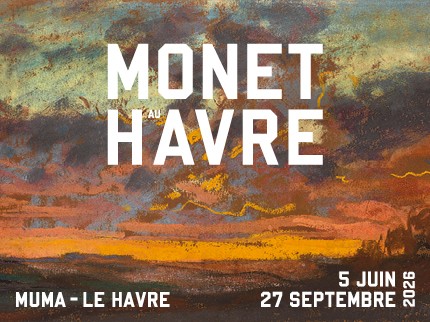
To mark the centenary of the death of Claude Monet (Paris, 1840–Giverny, 1926), MuMa presents an unprecedented exploration of the youth of the father of Impressionism via the exhibition “Monet in Le Havre”.
The exhibition reveals how the thirty years the painter spent in Le Havre and Paris were crucial in shaping Monet’s gaze and technique, from his earliest sketchbooks to maritime landscapes and port scenes.
In the course of an itinerary featuring nearly 100 artworks and archival documents from renowned museums and galleries, some public and some private, and the collections of the artist’s descendants, it sheds new light on Monet’s links with the city of Le Havre.
GROWING UP IN LE HAVRE
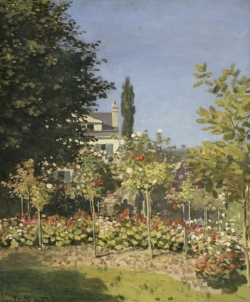
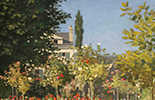
Claude MONET (1840-1926), Jardin en fleurs - à Sainte-Adresse, vers 1866, oil on canvas, 64 x 53 cm. . © RMN-Grand Palais (musée d’Orsay) / Hervé Lewandowski
It was in Le Havre that the young Monet took his first steps as an artist. He filled his sketchbooks with drawings from life, mischievously caricaturing prominent citizens, produced his first landscapes in the company of Eugène Boudin, then Johan Barthold Jongkind, absorbed the teachings of his masters and composed his first still lifes. As he oscillated between the city where he grew up and Paris, where he met the future Impressionists, his gaze was gradually formed and his ambition confirmed.
In Le Havre, he also encountered photographers, who had been lured there by the picturesque subjects it offered or the technical challenges presented by a fast-changing port city. Their pictures provided a pool of subjects that recur in his oeuvre. Be it the wild landscapes of the headland of La Hève in Sainte-Adresse, known locally as the “world’s end” and a favourite spot with the denizens of Le Havre, the regattas in which the roadstead teems with sailing boats, or the heart of the great industrial port, Monet’s Norman paintings recount the birth of a painter and of a modern way of seeing.
HIS FIRST SUPPORTERS
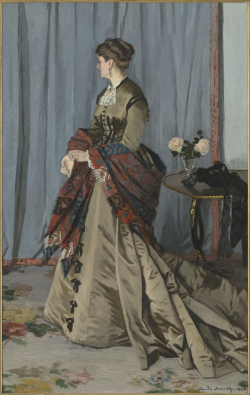
Claude MONET (1840-1926), Madame Louis Joachim Gaudibert, 1868, oil on canvas, 216.5 x 138.5 cm. . © GrandPalaisRmn (musée d'Orsay) / Hervé Lewandowski
With the aid of hitherto unseen archival documents, the exhibition presents the artist’s family circle, Le Havre society and its decisive influence on Monet, the young painter’s sources of inspiration, his early training as an artist, his many caricatures, the places he chose to depict, how his technique developed and the vital role played by his first collectors. A detailed chronology, maps of the area and extracts from correspondence – many of them never previously displayed – will shed uniquely valuable light on the origins of an oeuvre and the career of an artist who was to change the course of the history of painting.
THE EXHIBITION ITINERARY
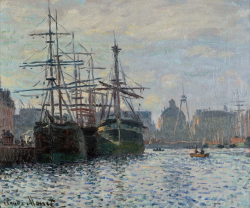
Claude MONET (1840-1926), Le Bassin du Commerce, Le Havre, vers 1874, oil on canvas, 37 x 45 cm. . © Musée des Beaux-Arts de Liège/La Boverie
1. Growing up in Le Havre
2. Monet’s first sketchbooks (1856) and first painting (1858)
3. Monet and still life
4. Caricatures, Le Havre and Paris
5. Monet’s and Boudin’s pastels of skies
6. Gustave Le Gray and photographers in Le Havre in 1856
7. Maritime and port landscapes
8. Art patrons in Le Havre
9. Monet’s gift to the City of Le Havre, 1910
10. Water Lilies #1 and #2 by Ai Weiwei, 2022.
AI WEIWEI, WATER LILIES #1 ET #2, 2022
A CONTEMPORARY GARDEN
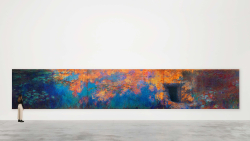
Ai Weiwei, Water Lilies # 1, 2022, . . © Ela Bialkowska
From his memory of this arose an unusual reinterpretation, in which the industrial, serially produced coloured bricks are substituted for the Impressionist brushstrokes without losing the meditative impetus. Ai Weiwei’s Water Lilies are also a filial gesture. They pay homage to the artist’s father, a poet who studied in Paris and was profoundly influenced by Impressionism, but was silenced by the communist regime when he went back to China.
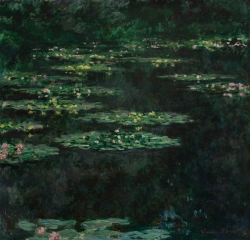
Claude MONET (1840-1926), Waterlilies, 1904, oil on canvas, 89 x 93 cm. . © MuMa Le Havre / David Fogel
Exhibit curated by
Géraldine Lefebvre, Director of MuMa
and Philippe Platel, Director of the Normandy Impressionist Festival.
►As part of the Normandy Impressionist Festival 2026

The exhibition “Monet in Le Havre” has benefited from exceptional support from the Musée d’Orsay and the Musée Marmottan Monet, which have fully associated themselves with its development via loans of artworks and specialist input. It assembles artworks from leading institutions in France and other countries including the National Gallery in London, the National in Edinburgh and the National Gallery of Art in Washington, the Minneapolis Institute of Art, Denver Art Museum and Cleveland Museum of Art, Ordrupgaard in Charlottenlund, near Copenhagen, and La Boverie in Liège, the Clark Art Institute in Williamstown, the Museum of Modern Art in Saitama and Tochigi City Museum of Art in Japan, the Musées de Honfleur, the Musée des Impressionnismes Giverny, the Musée des Beaux-Arts de Rouen and the Bibliothèque nationale de France. In addition, Claude Monet’s descendants have consented to lend artworks that have never previously been displayed, such as the portrait of the artist’s father and one of his earliest sketchbooks, for the exhibition.
 |  |
►This exhibition is presented on the occasion of the 9th edition of Un Été Au Havre, a summer cultural season.
EN SAVOIR +
Publications
Monet au Havre
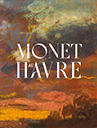
MuMa musée d’art moderne André Malraux, Le Havre, 5 juin - 27 septembre 2026
Couverture reliée - 23 x 29 cm - 288 pages - 35€
Édition : MuMa / Editions Octopus